
The relation between a regulator and its regulated entities is collaborative and not adversarial with the common objective of maintaining the stability and credibility of the financial system. However, the action on regulated entities like penalties and business restrictions are the last resort, Reserve Bank of India (RBI)'s governor Sanjay Malhotra said on Friday.

Sanjay Malhotra on Wednesday took charge as the 26th Governor of the Reserve Bank of India. Malhotra, a career bureaucrat, arrived at the central bank's headquarter this morning, where he was welcomed by senior RBI staffers. The central bank confirmed Malhotra's appointment through a post on the microblogging site "X" and also shared a few pictures.

The government on Monday appointed Revenue Secretary Sanjay Malhotra as the 26th Governor of the Reserve Bank of India. The Appointments Committee of the Cabinet cleared Malhotra's name, who has been appointed as the RBI Governor for three years, starting Wednesday. Malhotra, a 1990 Batch Rajasthan Cadre IAS Officer, will replace Shaktikanta Das, whose tenure ends on Tuesday (December 10, 2024).

Large tariffs by the United States administration and elevated geopolitical risk have increased near-term global financial stability risks, and along with weather events pose downside risks to domestic growth, Reserve Bank of India (RBI) Governor Sanjay Malhotra said in the foreword to the Financial Stability Report released on Monday.
Reserve Bank of India (RBI) Governor Sanjay Malhotra on Wednesday said regulations should not create unintended barriers to financial inclusion while emphasising that the impact of regulations on individuals and businesses should be considered.
Reserve Bank of India Governor Sanjay Malhotra has stated that the rupee may be 'undervalued' by many estimates and assured that the RBI will work to ensure its stability and help it find its 'correct value' amidst recent depreciation.

His remarks come amid a debate over whether Tata Sons, the holding company of India's largest conglomerate Tata group, is required to go public.
Since Sanjay Malhotra took office as governor in December, the Reserve Bank of India (RBI) has adopted a more accommodative stance, which bodes well for banking and the economy as they navigate a growth slowdown, according to analysts.
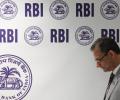
The Reserve Bank of India on Wednesday raised its policy repo rate by 25 basis points to 5.50 per cent, beginning a rate-hike cycle as rising inflation risks, elevated global yields and resilient domestic growth strengthened the case for tighter monetary policy. The decision by the Monetary Policy Committee marks a shift from its August policy, when it kept the repo rate unchanged at 5.25 per cent and retained a neutral stance while seeking greater clarity on the inflation outlook and growth-inflation balance.

Reserve Bank of India (RBI) Governor Sanjay Malhotra stated that surplus liquidity in the banking system is expected to drain within the current financial year, utilising tools like currency leakage, sell-buy swaps, open market operations (OMOs), and variable rate operations.

RBI Governor Sanjay Malhotra reiterated India's cautious stance on cryptocurrencies due to concerns over monetary sovereignty and capital flows, while actively promoting underlying technologies like distributed ledger technology and tokenisation. He also addressed the global rise in public debt and hardening bond yields, attributing it to increased government and private spending, including that driven by AI, and noted the implications of global interest rates on India's monetary policy.

"Pressure on the current account is a temporary problem. Sooner rather than later, our external sector will improve," said RBI Governor Sanjay Malhotra.

The Reserve Bank of India (RBI) has increased its GDP growth forecast for the current fiscal year (FY27) by 40 basis points to 7.1 per cent, acknowledging the resilience of domestic economic activity despite global headwinds and geopolitical tensions.

RBI Governor Sanjay Malhotra stated that the central bank consistently views fintechs as 'valuable partners' in shaping India's future financial system, crediting the sector with expanding financial inclusion, enhancing customer experience, and streamlining credit delivery, particularly for MSMEs.
The Reserve Bank of India (RBI) has issued a consolidated cybersecurity rulebook for all non-bank payment system operators (PSOs), including annual system audits and third-party ATM switch providers, to address vulnerabilities posed by artificial intelligence.

RBI Governor Sanjay Malhotra announced plans to launch long-lasting polymer currency notes by the next financial year. He also discussed the central bank's data-dependent approach to interest rates, its focus on aligning inflation with the 4 per cent target, and the orderly trajectory of the rupee amidst geopolitical tensions.
The Reserve Bank of India (RBI) is expected to cut interest rates for the first time in nearly five years in Governor Sanjay Malhotra's first monetary policy committee (MPC) meeting on Wednesday. The meeting of the six-member MPC, which will culminate on Friday, aims to boost sluggish economic growth, which is seen falling to a four-year low. Malhotra took charge as the 26th RBI governor in December last year.

RBI Governor Sanjay Malhotra stated it is "premature" to discuss the implementation of Merchant Discount Rate (MDR) for digital payments, advising a "wait-and-watch" approach. He emphasised that investment in public payment infrastructure is necessary and someone must bear the cost, whether through taxes or MDR. The government is currently working on amendments to relevant statutes, and the RBI is focused on strengthening this infrastructure.

Bollywood stars arrived with partners and family at Manish Malhotra's Diwali bash.

The Reserve Bank of India (RBI) has introduced new features for India's digital payment ecosystem, including UPI tap-to-pay for PIN-less transactions up to 5,000 and multi-currency capabilities for forex on Bharat Connect, supporting Euro, British Pound, and other major currencies.

Indian stock markets closed lower, with the Sensex falling 429 points, after the Reserve Bank of India raised its benchmark interest rate for the first time in nearly four years, coupled with rising crude oil prices and persistent foreign fund outflows.
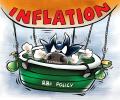
The Reserve Bank of India (RBI) has marginally raised its retail inflation forecast for the current fiscal year (FY27) to 5.2 per cent from 5 per cent, citing increasing price pressures across various commodities. Concurrently, the Monetary Policy Committee (MPC) unanimously decided to hike the key interest rate (repo) by 25 basis points to 5.5 per cent, shifting its stance to 'calibrated tightening'.

N Chandrasekaran and Noel Tata are expected to attend the Tata Steel board meeting on November 7 to approve Q2 results and the Tata Sons board meeting in the second half of November.

'Once this entire AI and tech driven euphoria in the Western markets sees a correction there will be a re-evaluation of the Indian equity market and inflows will resume.'

"Our endeavour is to bring headline inflation in line with the target over the medium term," said RBI Governor Sanjay Malhotra, addressing concerns about the central bank's policy stance and economic outlook.

The Reserve Bank of India (RBI) has maintained its benchmark policy rate at 5.25 per cent for the fourth consecutive meeting, prioritising clarity on inflation trends, particularly concerning energy costs and geopolitical developments.

The Kapoors' annual Karva Chauth celebration was a star-studded affair, with Bollywood's leading ladies and their families coming together at Anil and Sunita Kapoor's Mumbai home.

Sonia Gandhi's memoir, "Belonging: A Journey of Love," reveals for the first time her profound grief over the loss of her first child, a boy born prematurely in January 1969. The intensely personal account details the family's brief joy, the baby's subsequent death, and the difficult decision regarding his burial at Feroze Gandhi's farm in Mehrauli, alongside the emotional toll and public scrutiny she faced.

The Reserve Bank of India has marginally increased its GDP forecast for the current fiscal to 6.7 per cent while slightly lowering the inflation projection to 5 per cent. The central bank noted that while domestic economic activity shows resilience, global turbulence, particularly re-escalating conflicts and volatile oil prices, continues to pose risks to the inflation outlook.

Rashmika Mandanna, Kriti Sanon, Ranveer Singh, Gauri Khan and more stars celebrate Swadesh's first anniversary in style, dressed in stunning traditional ensembles.

The Reserve Bank of India's Monetary Policy Committee (MPC) has indicated that rate cuts are improbable in the near term, with headline inflation projected to reach 6 per cent in the third quarter. Minutes from the October meeting reveal growing concerns among members about inflation spreading beyond food and fuel, leading to a shift in policy stance towards calibrated tightening.

All the news in the latest celebration in town.

The RBI can slow the rupee's fall, but lasting stability depends on tackling the root causes of depreciation and attracting foreign investment.

'We see a lot of cases of bank deposits getting lost, especially when people die, so this will help address that because you have one consolidated view.'

Tata Sons, the holding company of the Tata group, continues to be classified as an 'upper-layer non-banking financial company' (NBFC) by the Reserve Bank of India (RBI), despite its application to deregister as an NBFC-Core Investment Company (CIC) remaining under consideration. This classification subjects it to enhanced regulation and a mandatory listing requirement, which remains uncertain.

From Baadshah to Happy Patel: Khatarnak Jasoos, these spy comedies prove that espionage can be a laughing matter, even when promising premises go sometimes spectacularly off course.

Foreign Currency Non-Resident (Bank), or FCNR (B), deposits mobilised under the Reserve Bank of India's (RBI's) concessional swap facility may have already surpassed the amount raised during the 2013 scheme in just about 45 days, prompting SBI Research to sharply raise its estimate for inflows under the facility to $65-70 billion.

India's markets regulator Sebi has launched 'Demat 2.0', a pilot project for tokenisation of corporate bonds, enabling atomic settlement through integration with RBI's wholesale CBDC. This new market infrastructure uses Distributed Ledger Technology (DLT) to make bond issuance, trading, and settlement faster and more efficient. India is the first country to issue corporate bonds natively on a distributed ledger with central bank digital currency settlement. Additionally, RBI Governor announced new UPI innovations: 'Tap & Pay' for faster POS transactions and MyUPI, an AI-powered customer support solution.

The Lok Sabha has passed a Bill to amend the Payment and Settlement Systems Act, 2007, authorising the government to permit banks and service providers to levy charges on UPI and other electronic payment modes. This move aims to create a sustainable revenue model for the digital payments ecosystem, shifting from the current exemption of UPI transactions from such charges.

'If the war continue for a longer period of time, it is just a matter of time before the government will pass on some of the price increases.'
